

Did you know that a single 1-star review can drastically tank your business rating? When calculating how many 5-star reviews to cancel a 1-star, the math might surprise you.
Studies show that a staggering 97% of people read reviews for local businesses before making decisions. Furthermore, Google hosts 73% of all online business reviews, making it the dominant platform for consumer feedback. However, most businesses need approximately 10 Google reviews just to start ranking in local searches.
When it comes to damage control, the numbers get even more challenging. To counteract a single 1-star review and regain a positive overall rating, you’ll typically need between 10 to 20 new 5-star reviews. In fact, on average, businesses need about 30 to 40 positive reviews to move their rating up by one full star.
If you’re wondering how many Google reviews you need or searching for a reliable Google rating calculator, you’re in the right place. In this article, we’ll break down the real mathematics behind your Google star ratings and provide practical strategies to help you effectively manage your online reputation.
How Google Ratings Work
Understanding Google’s rating system is essential for managing your business reputation online. The search giant uses a specific methodology that can make even a single negative review quite impactful.
What affects your average rating
Google calculates business ratings on a scale from 1 to 5 stars, with 5 being the highest possible rating. Your review score represents the average of all ratings published for your business, although this average isn’t updated instantly—it can take up to two weeks for a new review to affect your displayed rating.
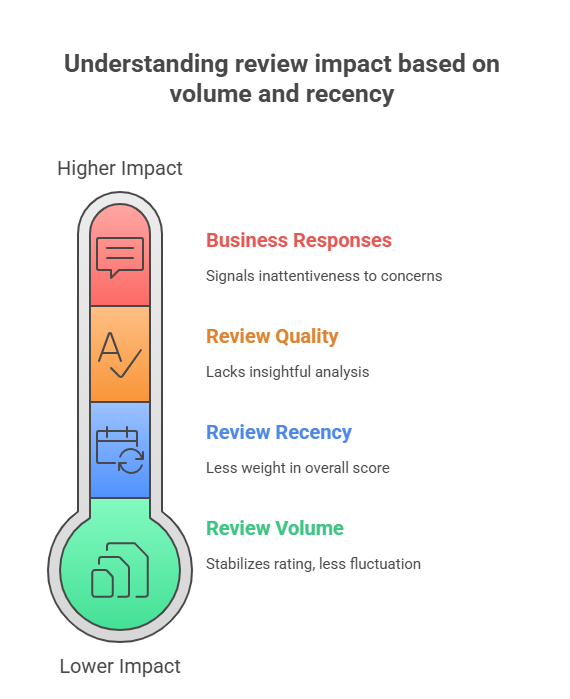
Several factors influence this calculation:
Review Volume: The total number of reviews affects how much each new review impacts your overall score. Businesses with more reviews have greater rating stability, while those with fewer reviews see larger fluctuations with each new feedback.
Review Recency: Google’s algorithm gives more weight to newer reviews than older ones. This means recent negative feedback can disproportionately affect your score, despite an otherwise positive history.
Review Quality: The review system prioritizes high-quality content that provides insightful analysis from knowledgeable individuals. Well-written, detailed reviews potentially carry more weight than brief or generic ones.
Business Responses: How you engage with reviews matters. Responding to customer feedback signals to Google that you’re active and attentive to customer concerns, potentially boosting your visibility.
Why a single 1-star review matters more than you think
The mathematical impact of a single 1-star review can be surprisingly significant, especially for businesses with fewer reviews. Consider these scenarios:
A business with 10 reviews and a 4.5-star rating drops to 4.2 stars after receiving one 1-star review. To regain their 4.5 rating, they’d need six new 5-star reviews.
Meanwhile, a business with 50 reviews and the same 4.5-star rating would only drop to 4.4 stars after a 1-star review, requiring the same six 5-star reviews to recover.
Beyond mathematics, ratings directly influence consumer behavior and your business visibility:
Search Visibility: Google considers your average rating when determining local search rankings. Businesses with higher ratings are more likely to appear prominently in search results, particularly for queries containing words like “best” or “top”.
Click-Through Rates: Higher star ratings significantly boost click-through rates from search results. According to research, a mere 0.1 rating increase can improve conversion rates by approximately 25%.
Purchase Decisions: Purchase likelihood peaks when ratings fall between 4.2 and 4.5 stars. Dropping below this threshold due to negative reviews can directly impact your conversion rates.
Trust Signals: Since 98% of consumers read online reviews, your average rating serves as an immediate trust signal. A single negative review can create a lasting negative impression, especially without a thoughtful response.
Additionally, for searches containing terms like “best” or “top,” Google automatically applies a “Top-rated” filter, showing only businesses with ratings of 4 stars or higher. Consequently, businesses hovering around this threshold may disappear entirely from these high-intent searches after receiving negative reviews.
Using a reliable google rating calculator or 5 star review calculator can help you determine exactly how many positive reviews you’ll need to offset negative ones based on your current metrics.
How Many 5-Star Reviews You Need to Cancel a 1-Star
The mathematics behind review ratings often feels mysterious, but it follows clear patterns. When I’m helping business owners understand the impact of negative reviews, I notice most are stunned by the actual numbers required for damage control.
Using a Google rating calculator
A Google rating calculator reverses the standard averaging formula to show exactly how many positive reviews you’ll need to achieve your target rating. These specialized tools require three key inputs:
- Your current average star rating
- Your total number of existing reviews
- Your desired future rating
Upon entering these figures, the calculator performs the necessary calculations instantly, saving you from complex mathematical formulas. Several reputable online calculators exist specifically for this purpose, with each providing slightly different features:
- Some focus purely on the math, showing how many 5-star reviews are needed
- Others offer visualization tools to help you set realistic goals
- Advanced calculators may factor in potential future negative reviews
These calculators consistently demonstrate one crucial fact: negative reviews require substantial positive feedback to counterbalance.
Example scenarios with different current ratings
The impact of a single 1-star review varies dramatically depending on your starting position:
| Current Rating | Total Reviews | After 1-Star | 5-Stars Needed to Recover |
|---|---|---|---|
| 5.0 | 5 | 4.0 | 1-2 |
| 4.5 | 20 | 4.3 | 4-6 |
| 4.0 | 100 | 3.97 | 10-15 |
| 4.8 | 50 | 4.7 | 10-20 |
As your review count grows, each new review has proportionally less impact. For instance, a business with around 50 reviews needs between 10-20 new positive reviews to increase its rating by just one decimal point after a negative review brings it down.
The mathematical reality is sobering: the higher your current rating, the harder it becomes to maintain or improve it, requiring more positive reviews to counter a single negative one.
How many 5-star reviews to offset a 1-star review
Generally speaking, you’ll need multiple 5-star reviews to neutralize a single 1-star submission. For businesses with fewer than 10 reviews, 1-2 positive reviews might raise your score by 0.1 points. Nevertheless, recovering fully often requires more substantial effort.
Consider this real-world scenario: if your 5-star rating drops to 4.2 after receiving a 1-star review, you’ll need approximately 15 new positive reviews to climb back to 4.8.
The specific formula works as follows:
- Multiply your current average by total reviews to get total points
- Add the number of new 5-star reviews multiplied by 5
- Divide by the sum of current reviews plus new reviews
For businesses with fewer total reviews, each negative review creates a larger impact. If you maintain only five total reviews with a perfect 5-star rating, a single 1-star review will immediately drop your average to just above 4.0.
Research from Northwestern University offers one strategic insight: purchase likelihood actually peaks for products with ratings between 4.2 and 4.5 stars. This suggests that focusing on maintaining a strong rating within this range, rather than pursuing a perfect 5.0, might be more practical and effective for your business goals.
First and foremost, understanding these mathematical realities helps you set realistic expectations for review management. Subsequently, you can develop targeted strategies to generate the specific number of positive reviews needed to maintain your optimal rating.
How to Calculate Your Review Score
Calculating your Google review score might seem complex at first, yet the process is fairly straightforward once you understand the underlying formula. Let’s dive into different methods for determining exactly where your business stands.
Manual formula to calculate average rating
Essentially, your Google rating operates as an arithmetic mean of all ratings received. The basic formula works as follows:
Average Rating = Sum of all individual ratings ÷ Total number of ratings
For instance, if your business has:
- 20 five-star reviews
- 7 four-star reviews
- 1 three-star review
- 1 two-star review
- 2 one-star reviews
The calculation would be: (20×5 + 7×4 + 1×3 + 1×2 + 2×1) ÷ 30 = 4.5 stars
This manual approach gives you complete visibility into how each new review affects your overall score, which helps in planning your review management strategy.
Using a 5-star review calculator tool
Alternatively, various online calculators simplify this process, allowing you to:
- Enter your current rating and review count
- Set a target rating
- Instantly see how many 5-star reviews you need
These calculators reverse-engineer the standard formula to determine the precise number of positive reviews needed. Moreover, they automatically factor in Google’s rounding system, eliminating the need for guesswork.
When searching for “Google rating calculator” or “5-star review calculator,” look for tools that allow you to input detailed information about your current review distribution for more accurate results.
Understanding Google’s rounding system
Unlike many platforms that round to the nearest half-star, Google rounds ratings to the nearest tenth decimal place. This subtle difference creates interesting threshold opportunities.
For example, if your business achieves a 4.95 average rating, Google will display this as a full 5.0 stars on your business profile. Similarly, a 4.85 would appear as 4.9 stars.
As such, you don’t necessarily need to achieve a perfect 5.0 mathematical average to display a perfect score. Instead, you only need to reach the rounding threshold of 4.95 stars.
Keep in mind that after someone leaves a new review, it may take up to two weeks for Google to update your displayed score. Therefore, don’t panic if your newly calculated average doesn’t immediately reflect on your profile – Google verifies review authenticity before updating ratings.
Why Review Volume and Frequency Matter
Beyond just accumulating positive feedback to offset negative reviews, the volume and frequency of reviews play crucial roles in your overall Google visibility. Let me break down why these factors deserve your attention.
How many Google reviews do I need to rank?
Research consistently shows that hitting the 10-review threshold creates a noticeable ranking boost in Google’s local search results. Initially, this magic number serves as a minimum credibility marker that helps Google determine whether your business deserves visibility. Once you cross this threshold, you’ll likely see improved positioning in local search rankings.
Presently, this 10-review minimum applies regardless of your industry, though competitive markets may require substantially more. Beyond this initial boost, the ranking benefits follow a law of diminishing returns—meaning additional reviews still help but with progressively smaller impacts on your position.
Why consistent reviews help more than bulk reviews
Collecting reviews in bulk might seem efficient, yet this approach can backfire. Google’s systems flag suspicious patterns like suddenly adding 50-100 reviews in a single day. Continuous collection of recent reviews signals legitimacy to both users and search engines.
Review recency ranks as the third most important local ranking factor after star rating and legitimacy. As much as two-thirds of consumers consider reviews older than 90 days irrelevant. This explains why steady, ongoing feedback outperforms one-time collection efforts.
For optimal results, I recommend:
- Staggering review collection over time (e.g., spread 50 reviews across six months)
- Monitoring competitors’ review frequency to match or exceed it
- Responding to all reviews to encourage more engagement
Industry benchmarks for review counts
Different industries have widely varying expectations for review volume. Understanding these benchmarks helps set realistic goals:
| Industry | Optimal Rating | Target Review Count |
|---|---|---|
| Digital Agencies | 4.2-4.5 stars | 50+ |
| Home Services | 4.4-4.7 stars | 100+ |
| Hospitality | 3.8-4.5 stars | 500+ |
| Retail | 4.5-4.7 stars | 300+ |
| Healthcare | 4.3-4.8 stars | 50+ |
| Technology | 4.0-4.5 stars | 700+ |
| Financial Services | ~3.3 stars | ~9 |
Notably, businesses with fewer than 10 reviews in competitive industries face significant challenges. Financial service providers, in this case, often have single-digit review counts, making each feedback critically important.
Remember that recency trumps sheer volume—six timely reviews may provide more ranking benefit than 60 older ones. In the long run, maintaining a steady stream of at least 10 reviews per quarter ensures reviews contribute effectively to your search position.
Smart Ways to Get More 5-Star Reviews
Getting more 5-star reviews requires strategic action, not just hoping customers will share their positive experiences. After calculating how many positive reviews you need to counteract negative ones, you need practical ways to generate them.
Ask at the right time
Timing significantly impacts review response rates. Research shows that asking for reviews 24-48 hours after a positive customer interaction yields the highest response rates. This timing captures customers while their experience remains fresh. Additionally, businesses that request reviews immediately after service completion or at “delight moments” when customers express satisfaction see much higher conversion rates.
Use review request links and QR codes
Making the review process effortless dramatically increases participation. Google offers an official way to generate and share review links directly from your Business Profile. These direct links eliminate friction by guiding customers straight to your review page without searching. QR codes provide an even simpler option—customers simply scan with their phones to leave feedback instantly. Place these codes on receipts, business cards, or checkout counters. About 70% of reviews come from businesses actively requesting them, making these tools essential.
Incentivize ethically
While directly incentivizing Google reviews violates platform policies, you can encourage feedback ethically by:
- Making the process easy with direct links
- Being transparent with messaging like “We love honest feedback!”
- Training staff to naturally request reviews
- Focusing on exceptional service first
Respond to all reviews to encourage more
Businesses that respond to reviews are seen as 1.7 times more trustworthy than those who don’t (76% vs. 46%). Responding to both positive and negative reviews demonstrates that you value customer feedback, creating a cycle that generates more reviews. Your responses should be authentic, appreciative, and concise—simply acknowledging the reviewer’s experience builds trust with future customers who read these interactions.
Conclusion
Managing your Google review profile requires both mathematical understanding and strategic action. Throughout this article, we’ve seen how a single 1-star review can dramatically affect your business rating, especially for businesses with fewer reviews. The real numbers behind review calculations demonstrate why proactive reputation management matters more than many business owners realize.
Your Google star rating serves as a critical trust signal that directly influences customer decisions. Most consumers check reviews before making purchase choices, with ratings between 4.2 and 4.5 stars proving optimal for conversion rates. Consequently, maintaining your score within this range should become a priority rather than chasing a perfect 5.0.
Review volume plays an equally important role. Businesses need a minimum of 10 reviews just to start appearing prominently in local searches, though competitive industries often demand significantly higher numbers. Additionally, consistent review collection trumps bulk acquisition attempts, as Google’s algorithm favors businesses with regular, recent feedback.
The math behind offsetting negative reviews might seem daunting at first. Nevertheless, understanding these calculations empowers you to set realistic goals and implement effective strategies. Whether you use a Google rating calculator or perform manual calculations, knowing exactly how many positive reviews you need creates clear targets for your review generation efforts.
Smart review acquisition tactics can dramatically accelerate your recovery from negative feedback. Asking at optimal moments, simplifying the process with direct links or QR codes, and responding thoughtfully to existing reviews all work together to generate more positive ratings. Above all, focusing on delivering exceptional customer experiences remains the foundation of any successful review strategy.
Remember that online reputation management represents an ongoing process rather than a one-time effort. By understanding the mathematical realities behind your Google ratings and implementing the strategies outlined in this article, you can effectively neutralize negative reviews while building a robust profile that attracts new customers and boosts your business visibility.
Was this helpful?