

Trustpilot is a website that is an essential part of reputation management. Trustpilot reviews are very important to increase your business’s credibility. Out of 100 customers, 70 are customers who are testing online services, so it is becoming important for us to maintain our reputation on review platforms like Trustpilot. A customer checks more than 10 reviews before purchasing a product or service. They buy it considering the good and bad sides of the product, but some bad reviews reduce the sales of the product.
Many companies want to convert 1-star reviews to 5 stars; this blog is for them. In this blog, we will see how to convert 1-star reviews to 5-star reviews. We have done this many times, and we have been successful in converting most of the reviews to 5-star reviews.
Why 1-Star Reviews Hurt More Than You Think
Negative feedback does far more damage to your business than most owners realize. The implications extend beyond just a dent in your ego, as they directly affect your bottom line, online presence, and long-term reputation.
Impact on search rankings and visibility
A single negative review can significantly undermine your search engine visibility. Search engines like Google consider reviews a key ranking factor for local searches, and losing positive reviews can dramatically reduce your visibility in search results. For businesses struggling with negative reviews, this decreased visibility translates to fewer website visits and conversions.
Search engines aim to provide users with relevant and valuable content, and a pattern of negative reviews signals that your site might not meet these criteria . Furthermore, businesses with low star ratings face higher advertising costs, as poor ratings make pay-per-click (PPC) advertising more expensive. With lower ratings, you’ll receive fewer organic clicks and pay more for ads, creating a costly cycle that’s difficult to break.

Loss of trust and credibility
Today’s purchasing process revolves around online reviews. According to studies, 87% of consumers read online reviews about local businesses , and 82% specifically seek out negative reviews to better understand what to expect . Moreover, 79% of consumers trust online reviews from strangers as much as recommendations from friends and family .
The financial impact is substantial – a single one-star review can lead to a 10% loss in potential new customers . For businesses with multiple negative reviews, revenue can plummet by up to 70%. Each lost star on Google could reduce your revenue by 5-9% in industries like hospitality and dining. Consequently, poor ratings make customer acquisition significantly more expensive – up to 25 times more costly than retaining existing customers.
The snowball effect of negative feedback
Negative reviews create a dangerous downward spiral. A bad first review doesn’t just reduce initial sales; it causes long-term damage by setting negative expectations that get amplified over time. Essentially, the first negative review carries disproportionate weight, as it can discourage future customers from purchasing, resulting in fewer reviews overall and preventing the opportunity for redemptive positive reviews.
The social ripple effect of negative reviews is particularly potent due to psychological factors:
- Confirmation bias leads people to give more weight to negative comments
- The bandwagon effect causes others to follow negative opinions
- Emotional contagion spreads negative sentiment to influence perceptions.
Furthermore, dissatisfied customers share their negative experiences widely – on average, a dissatisfied customer tells 10-20 people about their poor experience, while satisfied customers only tell about 8 people about their positive experiences.
Given these impacts, addressing negative reviews promptly becomes crucial for business survival. Despite this importance, over 50% of companies fail to answer customer complaints. which only accelerates the snowball effect of damage to their reputation and revenue.
Turning Negative Reviews into Positive Experiences
First, we need to hire a company like Social Media Management for review management so that they can monitor the review pages all the time. If you want, you can take this service from us. We will always keep an eye on your page and do very little so that if any bad reviews come, we can start working on it.
Identifying Real vs. Fake Customer Feedback
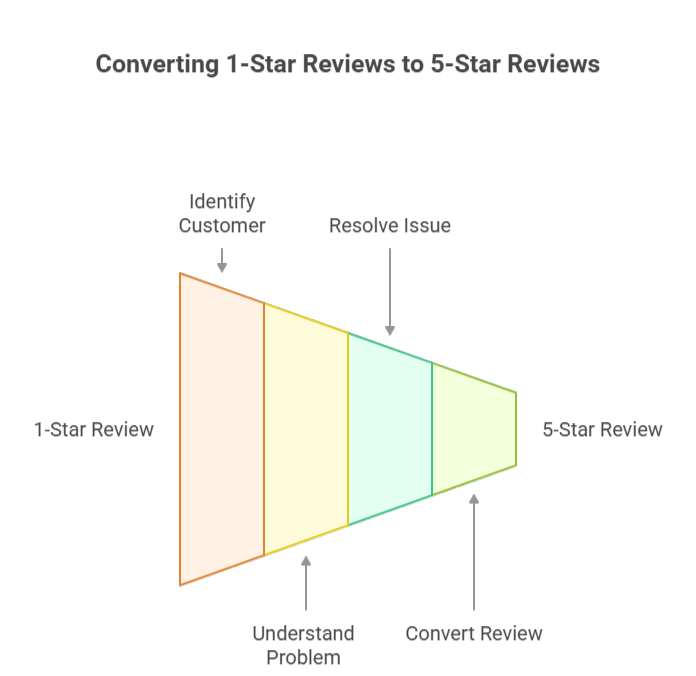
We first need to Identify whether this is a real review or a fake review. Many times, you will see that competitors pay money to provide 1-star reviews. We need to understand that if we see that there are too many 1-star reviews coming from people who are not your customers, then we need to quickly talk to Trustpilot customer support so that they stop showing reviews. If necessary, legal action will be taken if too many fake reviews are published.
What to Do If a Real Customer Leaves a 1-Star Review
We need to read the review comments and see why any customer has given a 1-star review. After that, we need to solve it. And we need to communicate with the customer so that the review is removed. If we can solve his problem, then he can get a 5-star review. But we need to communicate with the customer quickly. We need to see if the customer has any information or if we have an order history. But many times or in many business cases, there is no order history, or we cannot communicate with the customer in any way.
Resolve the Issue and Go the Extra Mile
After acknowledging the problem publicly, decisive action becomes your most powerful tool for earning that coveted 5-star review. The resolution phase is where you demonstrate your commitment to customer satisfaction through concrete steps and genuine care.
Offer a refund, replacement, or discount
When a customer feels wronged, financial acknowledgment speaks volumes. Offering a refund, replacement, or discount isn’t just about compensation—it’s a tangible demonstration of your commitment to making things right. Companies that provide swift solutions often turn dissatisfied customers into loyal advocates.
Consider these resolution options based on the situation:
- Complete refund for serious issues or major disappointments
- Product replacement when items arrive damaged or defective
- Complimentary services to counterbalance a negative experience
- Partial refunds or discounts on future purchases for minor issues
For example, one optometrist responded to a negative review about contact lenses by offering both a full refund and a complimentary session. Another business offered to defer a premium increase and refund the difference after a customer complaint.These gestures show you value the relationship beyond the immediate transaction.
Fix the root cause of the complaint
Resolution goes beyond appeasing individual customers—it requires addressing the underlying issues that created the problem. Studies show firms that conduct root cause analysis typically implement appropriate actions to prevent issues from recurring.
This approach benefits your business in multiple ways. First, it prevents similar complaints from other customers. Second, it demonstrates to the reviewer that their feedback genuinely helped improve your business. One company found that unclear pricing copy was causing confusion after a customer left a 2-star review. Their team immediately fixed the copy and reached out to share the updates—resulting in the customer upgrading to a 5 star review and maintaining their patronage.
Document all improvements in an action plan with designated owners, deadlines, and specific remediation actions.Subsequently, measure the effectiveness of these changes through ongoing monitoring of customer outcomes and feedback.
Add a personal touch to show you care
Personalization transforms standard customer service into memorable experiences. Automation may be efficient, but customers ultimately want to speak with a human being who genuinely cares about their problem.
The personal touch might include:
- Direct contact from a manager or owner for serious issues
- Personalized follow-up calls checking satisfaction with the resolution
- Handwritten notes acknowledging their feedback’s impact
- Named case handlers for escalated complaints.
One study found that 83% of surveyed customers feel more loyal to brands that respond to and resolve their complaints.Indeed, the true benefit of responding to negative reviews isn’t just appeasing the reviewer but showing potential customers that you care about their experience.
Remember—customers don’t want sympathy; they want empathy, ownership, resolution, and accountability.They need to know someone will see their issue through to completion.
What to do if the customer has no contact information?
In this era, every person uses social media, so we can find them on social media. If there is a CCTV camera, we can find Facebook and Instagram by looking at their face. However, this process may seem complicated to you. If the review profile uses a photo, then by searching Google with its name, many times their social media profile can be found. Once the profile is found, by knowing what the problem is, a 1-star review can be converted to a 5-star review by solving it.
Removing a Negative Trustpilot ReviewIf it is not possible to contact the customer in any way, we have to remove the 1-star review. There is a detailed blog on how to remove a 1-star review. You can visit our website if you want. Moreover, if our company is experienced in removing 1-star reviews, you can offer us this work, and we will work honestly. Moreover, if you read the blog carefully, you can remove the review yourself. |
The importance of converting 1-star reviews to 5-star stars
The importance of converting 1-star reviews to 5-star reviews cannot be overstated. Negative reviews can damage a business’s credibility, drive away potential customers, and lower overall ratings on platforms like Google, Yelp, or Trustpilot. However, when a dissatisfied customer is handled with care and professionalism, businesses have the opportunity to turn that negative experience into a positive one. By listening to the customer’s concerns, resolving their issues quickly, and showing genuine commitment to service, businesses often earn back trust.
When customers see their complaints taken seriously, they feel valued and may even update their review to a higher rating. This transformation not only boosts reputation but also demonstrates excellent customer service, building long-term loyalty. In today’s competitive market, converting 1-star reviews into 5-star reviews is a powerful growth strategy.
conclusion
Converting 1-star reviews into 5-star reviews is not just about improving ratings but about building lasting trust with your customers. Negative feedback provides businesses with an opportunity to showcase accountability, transparency, and genuine care. By identifying fake reviews, addressing real customer concerns, and maintaining open communication, companies can turn challenges into success stories. Each resolved issue demonstrates professionalism and strengthens customer relationships. Whether through proactive monitoring, professional review management, or personalized customer engagement, the effort invested in turning dissatisfied customers into satisfied ones pays off in reputation, loyalty, and long-term growth. Ultimately, transforming negative experiences into positive ones is the key to sustainable business success.
Was this helpful?