
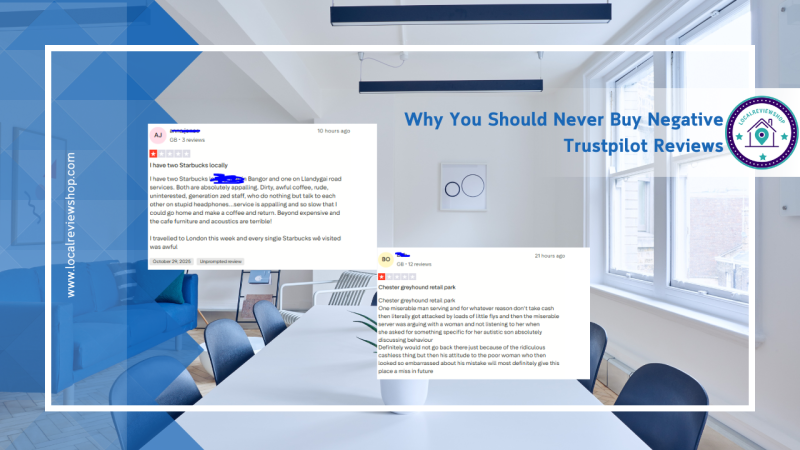
Thinking about buying negative Trustpilot reviews to hurt your competitors? I think you should never buy negative Trustpilot reviews. Negative Trustpilot reviews are given to your competitors, and you can use that money to improve your service quality and attract better customers. You may not know that fake negative Trustpilot reviews are removed if someone gives you an additional Trustpilot page.
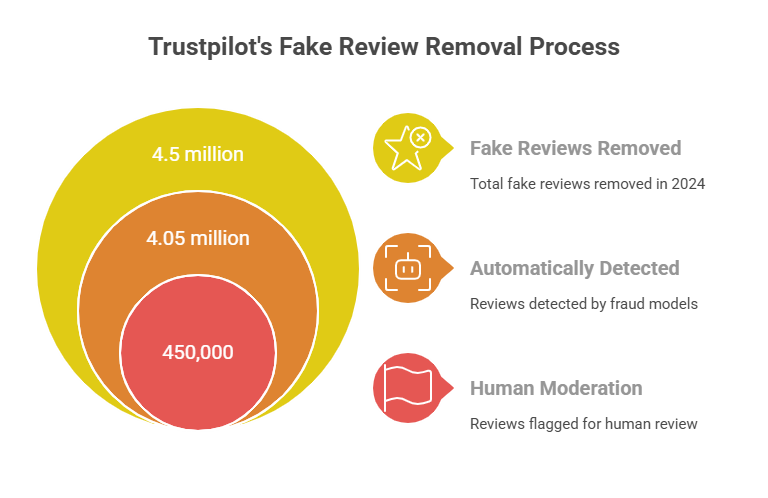
You may buy 1-star reviews for your competitors, and you can get 5 star reviews for your page. Let’s say you have 20 competitors and you give them 100 negative Trustpilot reviews, you will have to buy 2000 reviews, which is a lot of money. However, if you buy 2000 reviews for your page, you will get more customers for the same money. Think again. One of the world’s largest online review platforms, Trustpilot, removed 4.5 million fake reviews in 2024 alone. With over 300 million reviews and 67 million active users generating 127 billion brand impressions per month, Trustpilot has become a powerful force in consumer decision-making.
In fact, Trustpilot reviews influence the purchasing decisions of 67.7% of consumers. This explains why some businesses might be tempted to buy Trustpilot reviews, whether positive for themselves or negative for competitors. However, this approach carries significant risks. According to Forbes, approximately 94% of consumers avoid businesses with bad reviews, while a single negative review can drive away 22% of potential customers.
Throughout this article, we’ll explore the hidden dangers of purchasing fake negative reviews, how Trustpilot detects such fraud, and what legitimate alternatives exist for businesses seeking to manage their online reputation. Interestingly, 68% of consumers actually trust reviews more when they see both positive and negative feedback, suggesting that authentic reviews—even critical ones—are more valuable than fabricated perfection
What Trustpilot Allows and Prohibits
Trustpilot operates under a clear set of principles that guide its platform. Understanding these rules is essential if you’re considering ways to manage your online reputation – or wondering about the legality of attempts to buy negative Trustpilot reviews against competitors.
Open reviews from real customers
Trustpilot functions primarily as an open platform where anyone can share their genuine experiences. You don’t need to wait for an invitation to leave a review – the platform allows consumers to write reviews at any time based on their authentic interactions with businesses. This openness creates a level playing field where both positive and negative experiences can be documented, providing a more complete picture for potential customers.
Furthermore, reviewers maintain ownership of their content, giving them the freedom to edit or delete their reviews whenever they choose. This policy empowers consumers while ensuring the platform remains dynamic and reflective of real customer experiences.
Strict rules against fake or paid reviews
Trustpilot takes a zero-tolerance approach toward fake reviews. The platform explicitly prohibits writing, submitting, or being involved in procuring fake reviews. These include reviews that don’t reflect genuine service or buying experiences, as well as those intended to manipulate consumer perception or negatively target specific businesses.
To maintain integrity, Trustpilot employs a three-pronged approach to identify and remove fake reviews, involving:
- People (human moderators)
- Technology (automated detection systems)
- Community (flagging and reporting)
Notably, last year alone, Trustpilot removed 3.3 million fake reviews from their platform – approximately 6% of total reviews, with 79% of those removed automatically through fraud detection technology.
No review gating or filtering
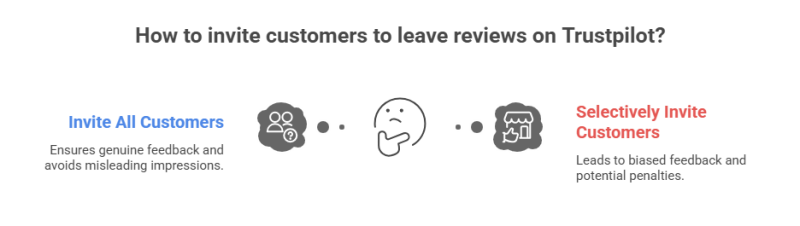
Businesses using Trustpilot must invite all customers equally to leave reviews – not just those who had positive experiences. The platform prohibits “review gating” – the practice of filtering out negative feedback by selectively inviting only satisfied customers.
Businesses that use biased invitation methods face serious consequences. For example, invitations that read “If you were happy with our services, please review us on Trustpilot. If not, please contact our customer support” are explicitly forbidden. Such practices prevent genuine negative feedback from appearing on the platform, creating a misleading impression of the business.
Essentially, Trustpilot requires that businesses invite all or none of their customers to write reviews. When complete coverage isn’t possible, companies must use an equally impartial system, such as inviting every third customer.
Incentives must be disclosed
Trustpilot maintains strict policies regarding incentives for reviews. The platform does not allow incentivized reviews of any kind. This means businesses cannot offer discounts, promo codes, prize draw entries, refunds, freebies, or any other benefits in exchange for reviews.
This aligns with the FTC’s final rule which prohibits “businesses from providing compensation or other incentives conditioned on the writing of consumer reviews expressing a particular sentiment, either positive or negative”. The FTC rule, which Trustpilot supports, specifically targets the practice of buying positive or negative reviews – making attempts to buy negative Trustpilot reviews against competitors not only against platform policies but potentially illegal.
By establishing these guardrails, Trustpilot works to maintain a trustworthy ecosystem where authentic customer voices prevail over manipulated narratives.
How Fake Negative Reviews Are Detected
The technology behind Trustpilot’s review authenticity system works tirelessly to maintain platform integrity. Attempting to buy negative Trustpilot reviews against competitors is increasingly difficult as detection methods grow more sophisticated each year.
Automated fraud detection systems
Trustpilot’s automated detection technology operates around the clock, analyzing every single review before it appears on the platform. In 2024 alone, the system processed nearly 200,000 reviews daily. This sophisticated technology combines machine learning, neural networks, and graph-based models to identify suspicious patterns and behaviors that indicate fraudulent activity.
The system is remarkably effective – in 2024, of the 4.5 million fake reviews removed from Trustpilot, an impressive 90% were automatically detected by these fraud detection models without requiring human intervention. Additionally, all new reviews face a two-hour delay before publication, giving the software time to thoroughly examine each submission.
Beyond just analyzing review content, the technology examines a comprehensive range of data points, including:
- IP addresses and location data
- Device characteristics and timestamps
- Behavioral patterns across millions of reviews
- Unnatural language patterns and review spikes
Manual moderation and flagging
Despite advanced automation, Trustpilot recognizes the importance of human oversight. Their Content Integrity and Fraud Investigation specialists work alongside the technology, identifying emerging patterns that bad actors use to manipulate the system.
When a review is flagged by either a business or consumer who believes it violates guidelines, the platform’s specialized team investigates. This three-pronged approach – combining people, technology, and community participation – creates multiple layers of protection against fraudulent content.
Trustpilot clearly states that simply disliking a rating or disagreeing with negative feedback isn’t sufficient reason for flagging. Nevertheless, when concerns about authenticity arise, the Content Integrity team performs a manual review to ensure fair decisions.
Verification requests for uninvited reviews
In certain scenarios, Trustpilot may ask reviewers to verify their experience with documentation. This typically happens when automated detection technology flags unusual patterns or when another user reports suspicious content.
During verification, Trustpilot looks for evidence connecting the reviewer to the claimed buying or service experience. This process helps maintain review credibility without unnecessarily removing genuine feedback.
To enhance transparency, verified reviewer accounts receive a ‘Verified’ label, giving potential customers greater confidence in the authenticity of those reviews.
Patterns that raise red flags
Through years of experience and technological advancement, Trustpilot has identified several patterns that commonly indicate fake reviews:
- Multiple reviews originating from the same IP address
- Unusual timing or suspicious posting patterns
- Reviews lacking specific details about the experience
- Unnatural language or excessive positivity/negativity
- Accounts with limited activity or repetitive review behavior
Since implementing enhanced detection measures, the proportion of detected fake reviews removed from Trustpilot increased from 6.1% in 2023 to 7.4% in 2024. This improvement demonstrates that the platform’s automated systems are becoming increasingly effective at identifying and removing fraudulent content – making any attempt to buy negative Trustpilot reviews increasingly risky and likely to fail.
The Hidden Dangers of Buying Negative Trustpilot Reviews
Attempting to manipulate Trustpilot’s review system comes with serious consequences that extend far beyond mere policy violations. Let’s examine why buying negative reviews against competitors is a dangerous gamble.
Violation of platform policies
Trustpilot maintains a zero-tolerance approach toward fake reviews. Their dedicated enforcement team actively investigates and takes action against those who undermine platform integrity. Consequently, businesses caught buying negative reviews face immediate penalties, including removal of the fraudulent content, account suspension, and public Consumer Warnings—prominent notifications explaining the business’s misconduct. In 2023 alone, Trustpilot removed 3.3 million fake reviews, representing about 6% of all reviews on the platform.
Legal consequences under consumer protection laws
The legal ramifications of purchasing fake reviews have intensified with recent legislation. The Federal Trade Commission (FTC) implemented a new rule explicitly banning fake reviews and testimonials. This rule prohibits businesses from creating, selling, or buying fake consumer reviews—whether positive or negative. Violators face substantial penalties of up to $51,744 per violation, with the FTC liberally counting infractions so that penalties often reach millions of dollars.
Moreover, the Digital Markets, Competition and Consumers Act 2024 makes it illegal to publish, commission, or facilitate fake reviews, with potential fines reaching up to 10% of global annual turnover or fixed penalties up to £300,000.
Loss of credibility and customer trust
The impact on consumer trust is perhaps the most damaging long-term consequence. Research indicates that fake reviews decrease informativeness, information quality, and effective use of online product reviews. When consumers discover they’ve been misled by manipulated reviews, trust in the company is severely compromised.
A survey of over 10,000 global consumers revealed how significantly fake reviews damage trust in brands. This erosion of trust is particularly devastating for small businesses, as it can result in:
- Decreased web traffic
- Reduced conversion rates
- Diminished customer loyalty
- Damaged partner relationships
Search engine penalties and SEO damage
Search engines like Google take review manipulation seriously. Businesses engaged in deceptive practices may experience ranking drops or removal of rich snippets. Since review count and review score help Google determine a business’s authority, manipulating these metrics can trigger algorithm penalties, making it harder for potential customers to find your business.
- Encourage Genuine Reviews: Post-purchase emails, incentives like discounts for honest feedback (compliant with Trustpilot rules).
- Respond Professionally: Address negatives publicly—turns critics into advocates. Businesses responding to 100% of reviews see 0.5-star boosts.
- SEO and Content Marketing: Rank higher in searches, reducing reliance on reviews.
- Customer Experience Overhaul: Fix root issues—better products, service.
- Partnerships and Influencers: Authentic endorsements trump fakes.
- Monitor and Report: If targeted, use Trustpilot’s tools to flag suspects.
Public backlash and brand damage
Once exposed, companies face severe public consequences. The revelation of deceptive tactics often leads to negative media attention and a substantial loss in sales. This damage can take years to repair, as rebuilding a reputation requires transparency and genuine improvement—not shortcuts.
Ultimately, buying negative Trustpilot reviews creates short-term illusions at the expense of long-term business viability.
Reputational Fallout: The Backfire Effect
Even if undetected initially, fake reviews often backfire spectacularly. Savvy consumers spot inauthenticity: overly dramatic language (“Worst company EVER!!!”) or inconsistencies (complaining about a product not sold).
The Streisand effect amplifies this—attempts to suppress or manipulate draw more attention. A competitor might counter with evidence, turning your sabotage into their PR win: “We’ve been targeted by jealous rivals—here’s proof we’re legit!”
Your own reputation suffers if linked. Whistleblowers from review mills leak client lists. Media outlets love these stories; headlines like “Local Business Caught Faking Rival Reviews” destroy credibility overnight.
Long-term, it poisons your brand. Customers value transparency—88% say authenticity is key when supporting companies. Association with dirty tactics makes you radioactive to affiliates, influencers, and investors.
Case in point: In 2021, a US supplement company was exposed for buying negative reviews against competitors. Sales plummeted 40%, and they faced boycotts. Recovery took years, if it happened at all.
Ethical and Competitive Implications
Beyond legal and financial risks, buying negative Trustpilot reviews raises profound ethical issues that extend throughout the business ecosystem. Let’s examine the moral implications of this deceptive practice.
Misleading potential customers
Fake negative reviews fundamentally violate consumer rights by depriving people of accurate information needed to make informed decisions. Potential customers waste both time and money when they base purchasing choices on manipulated content rather than authentic experiences.
FTC Chair Lina M. Khan emphasizes this concern: “Fake reviews not only waste people’s time and money, but also pollute the marketplace”. The Consumer Protection Act specifically protects consumers’ right to be informed about the quality, standard, and other aspects of goods or services.
Once consumers discover they’ve been misled by fabricated reviews, their trust collapses – not just in the targeted business, but in the entire review ecosystem. This erosion of confidence creates lasting damage that extends far beyond any short-term competitive advantage.
Creating unfair competition
Attempting to buy negative Trustpilot reviews directly “diverts business away from honest competitors” who focus on legitimate business improvement rather than underhanded tactics. This creates an uneven playing field where ethical businesses struggle against those willing to manipulate perception.
Real-world consequences of such behavior can be severe. In 2013, Samsung faced a $340,000 fine from Taiwan’s Fair Trade Commission for hiring people to post negative fake reviews about competitor HTC. Likewise, research confirms that restaurant openings often trigger waves of negative fake reviews targeting nearby established restaurants.
The FTC’s new rule specifically acknowledges that businesses cannot provide “compensation or other incentives conditioned on the writing of consumer reviews expressing a particular sentiment, either positive or negative”. This regulation recognizes how purchasing negative reviews creates fundamentally unfair market conditions.
Undermining the review ecosystem
Perhaps most concerning, buying negative reviews gradually erodes trust in the entire review ecosystem. When consumers cannot distinguish between authentic and fabricated opinions, they become increasingly skeptical of all reviews.
This undermines the value of legitimate feedback and diminishes consumer confidence in making informed choices. As one industry expert notes, by posting illegitimate reviews, “you will ultimately undermine consumer faith in these sites, thereby increasing their uncertainty and hindering their due diligence efforts”.
Overall, buying negative Trustpilot reviews represents more than just an unethical tactic against competitors – it’s a practice that damages the fabric of trust upon which modern commerce depends.
Better Alternatives to Buying Negative Reviews
Rather than risking your reputation by attempting to buy negative Trustpilot reviews, consider these legitimate strategies that build authentic trust with your audience.
Encourage genuine customer feedback
Soliciting honest reviews from all customers creates a balanced and credible online presence. Research shows that 77% of customers are willing to leave reviews when asked. Instead of filtering for only positive experiences, invite feedback after every purchase. This approach builds genuine credibility, as 64% of consumers actually prefer buying from responsive companies versus those that appear perfect.
Respond to negative reviews professionally
When negative feedback inevitably appears, your response matters tremendously. A staggering 87% of consumers read online reviews before making purchase decisions. By acknowledging concerns quickly and offering solutions, you demonstrate accountability. Businesses should aim to reply within one week, as faster responses correlate with improved reputation. Indeed, 88% of consumers would use a business that replies to all reviews, compared to just 47% who would patronize a business that doesn’t respond at all.
Conclusion
Attempting to buy negative Trustpilot reviews against competitors clearly represents a dangerous gamble with severe repercussions. First and foremost, Trustpilot’s increasingly sophisticated detection systems make such deception likely to fail, with 90% of fake reviews automatically identified and removed. Additionally, the legal landscape has shifted dramatically, with new FTC rules imposing penalties exceeding $50,000 per violation.
Beyond financial risk, this unethical practice destroys trust – not just with customers who discover the deception, but throughout the entire review ecosystem. The resulting damage to brand reputation often takes years to repair, if recovery happens at all.
Smart businesses recognize that legitimate alternatives exist that actually build sustainable success. Honest feedback collection, professional responses to criticism, and genuine customer service improvements yield far better long-term results. After all, 64% of consumers prefer companies that respond well to criticism over those with seemingly perfect records.
Trustpilot remains a powerful force in consumer decision-making precisely because people value authentic experiences – both positive and negative. Companies must therefore focus on earning genuine positive reviews rather than fabricating negative ones about competitors. This approach not only avoids potentially devastating consequences but also builds real credibility that drives sustainable growth.
The digital marketplace thrives on trust. Companies choosing honesty over manipulation will undoubtedly establish stronger foundations for lasting success in an increasingly transparent business environment.
Was this helpful?